Autumn Skies from Southern New Mexico
Meteorological Fall (Sept-Oct-Nov) is arguably one of the best times to get out to view the night sky from southern New Mexico. The temperature is usually comfortable, the summer monsoon's clouds are waning, and the winds tend to be modest. And there's a LOT in the night sky to observe.
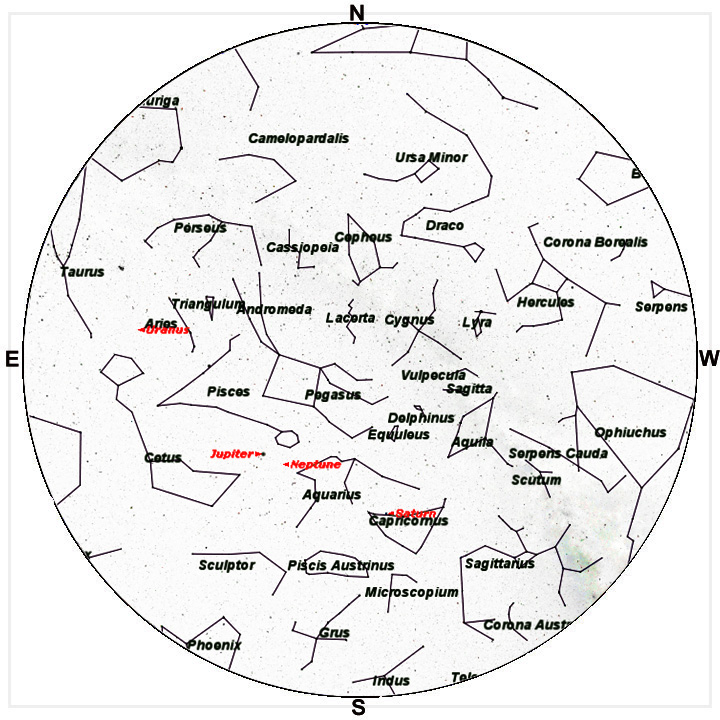
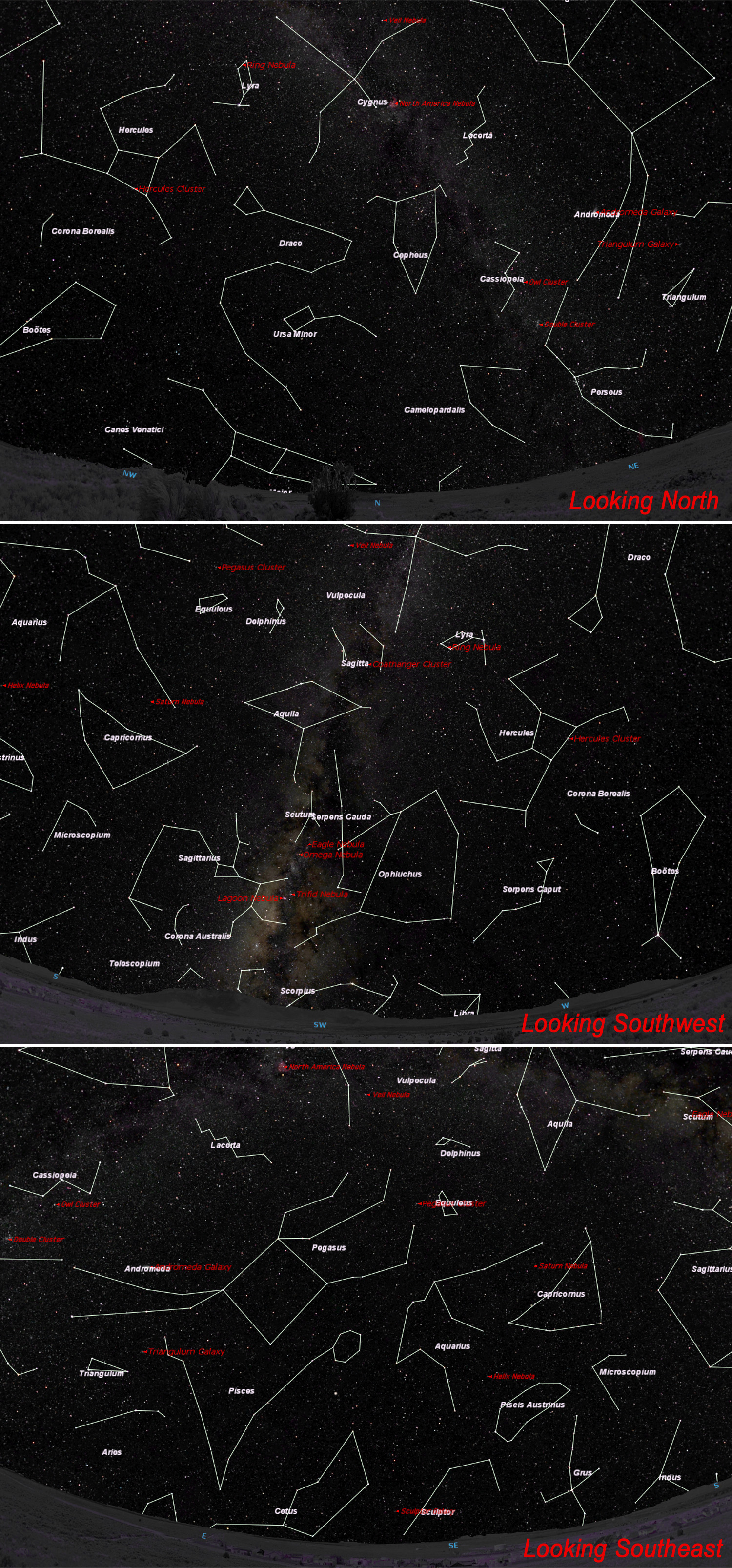
The charts to the right show a handful of selected objects visible in the Autumn night sky. Each chart depicta the night sky at around 10 pm (MDT) in mid-September or around 8 pm (MDT) in mid-October or around 6 pm (MST) in early-November. Clicking on the chart will bring up a much larger version.
Most of the features in the 'Summer' Milky Way are still visible in the southwest in the early evening including the bright nebulas M8 (Lagoon), M16 (Eagle), M17 (Omega or Swan) and M20 (Trifid). The 'teapot' asterism in Sagittarius is now steeply inclined. These regions will set fairly early in the evening (especially in November), so you'll want to view them as soon as it gets fully dark. The constellation, Hercules, as well as M13, the great Hercules globular cluster are also well placed for early evening viewing.
Looking Northward - the night sky is dominated by constellations such as Casseopeia (the vain Queen), the legendary hero, Perseus, and by Cygnus the Swan. Perseus is home of the Double Cluster (NGC 869 and NGC 884). These are bright open clusters each containing 100s of stars. These are relatively young clusters - perhaps only around 14 million years old. Definitely worth a look!
Casseopeia contains the Owl Cluster (NGC 457) as well as several other open star clusters. The pattern of stars is very owl-like (or perhaps Kachina Doll-like). It's easily viewed thru a small telescope. 50-60x works nicely.
Cygnus contains several beautiful deep space objects. I've highlighted the North America Nebula - a large emission nebula complex spanning the width of several moons, and the Veil Nebula complex, which includes NGCs 6960, 6992, 6995, 6974, and 6979. The Veil is the remnant of a supernova explosion occuring 10,000-20,000 years ago. Dark skies and a decent sized telescope are usually required to see much detail. Both make outstanding targetsl for astrophotography.
Just south of Cygnus lies the coathanger asterism (aka Brocchi's Cluster). It's not a true star cluster, but just a collection of stars that looks just like what the name implies. It's best viewed thru binoculars.
The Ring Nebula (M57) in Lyra is also highlighted as it is a popular target at any public outreach program (and very easy to find).
Looking toward the Southeast provides an opportunity to see 1 (or 2 if you're lucky) bright galaxies that can be viewed naked-eye. The brighter is M31 - the Andromeda Galaxy. Naked-eye, it looks like a faint smudge in the night sky. Binoculars shows the orientation and some of the structure of the spiral galaxy. The dimmer galaxy is M33 - the Triangulum Galaxy. Its surface brightness is very low, so it's difficult to see without binoculars or a telescope (unless the sky is very dark and your vision is very sensitive).
The Sculptor Galaxy (NGC 253) is shown low in the southeast. The galaxy never get very high in the sky, but nonetheless is a beautiful target for observing and astrophotography. A globular cluster (NGC 288) is positioned close enough to the galaxy that both are often visible in the same eyepiece or camera frame.
Two planetary nebula are visible in the southeast - the relatively close Helix Nebula (NGC 7293, 650 light-years distant) and the aptly-named Saturn Nebula (NGC 7009, 2000-4000 light-years distant). Either object requires a decent sized telescope to see much detail. The Helix is an outstanding astrophotography target - very colorful.
Obviously, the selected items in these charts represent just a small percentage of the DSO's (deep space objects) present in the Autumn sky, but hopefully, this piques your interst to have a look around.
Enjoy Autumn's Deep Sky Wonders!
rr